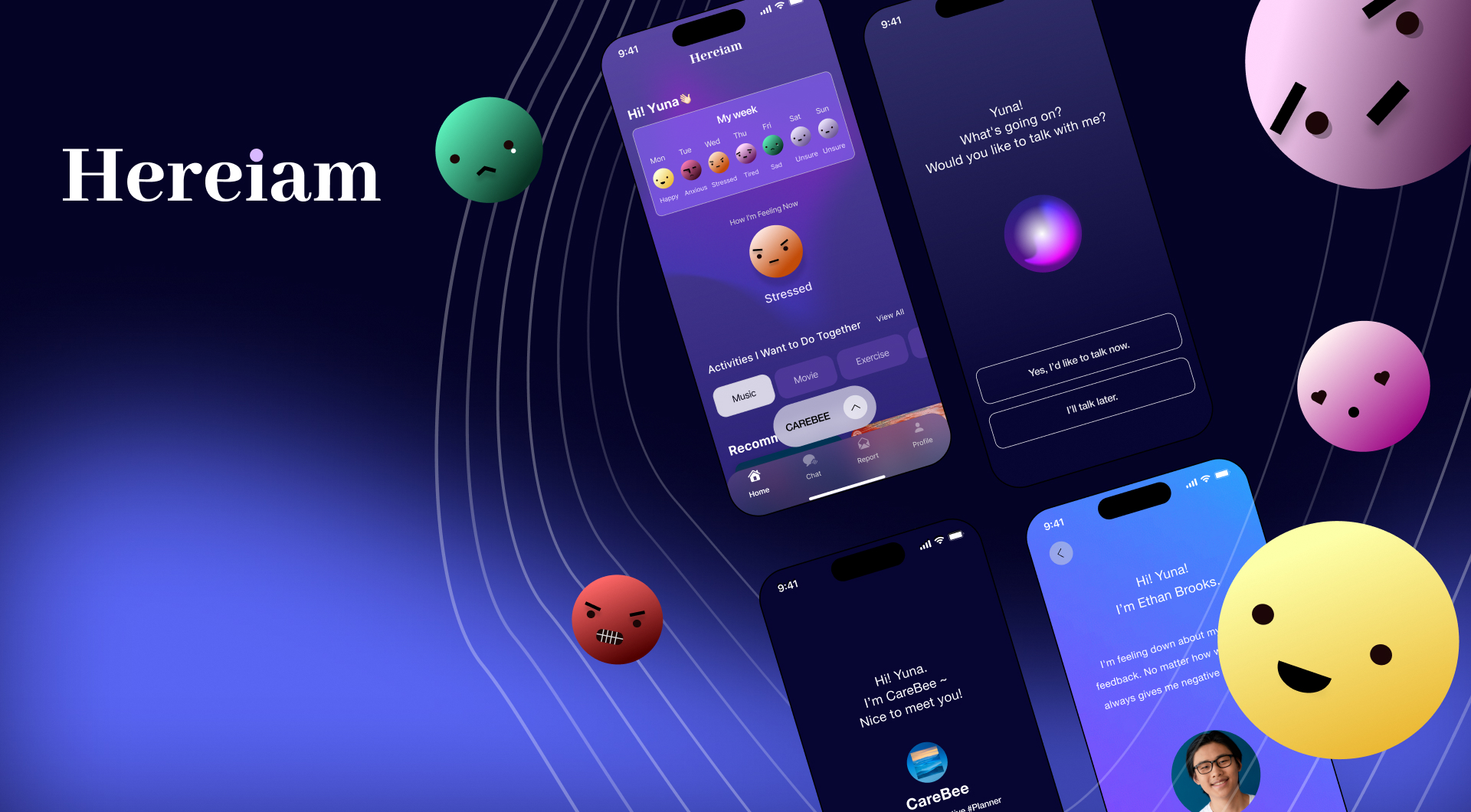
Hereiam is an AI-driven psychological care service that proactively reaches out to people exhausted by their daily lives, offering empathy and fostering connections with others.
This service is designed for modern individuals who find it difficult to relieve stress through conversations with others due to various circumstances or personal barriers, as well as for those who feel like they have no one to rely on.
Context
It has been found that this issue started with the advent of an overly competitive society, unlike in the past.
In the United States, the Amish, who continue to live according to traditional ways, are known to experience depression at a lower rate compared to people in other regions.
In Korea, many people have reported feeling unhappy with their lives due to constant social pressures, comparisons with others, and excessive competition.
Research >User Research
Survey
So, how do people cope with stress?
After experiencing severe stress leading to mental health issues,
- Professional help ( 11 peoples )
- Talk to someone ( 9 peoples )
- Took no action. ( 7 peoples )
This raises further questions:
Who would be the best person to confide in when someone chooses to “tell someone”?
And why do those who “take no action” prefer to be alone? Are they truly okay?
A second survey (46 respondents in total) was conducted to address the questions raised above.
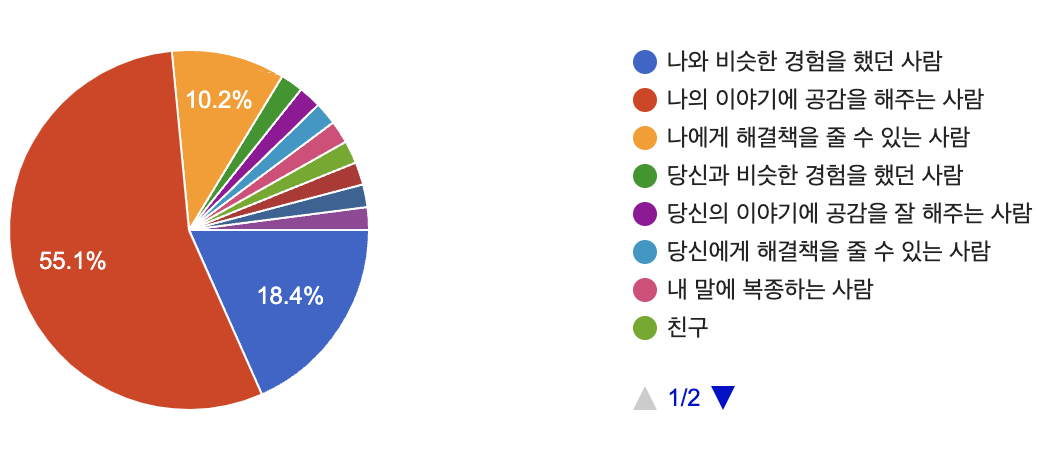
The characteristics of the person I want to confide in are mainly:
- Someone who empathizes with me (54.2%)
- Someone who has had similar experiences (18.8%)
- Someone who can offer solutions (10.4%)
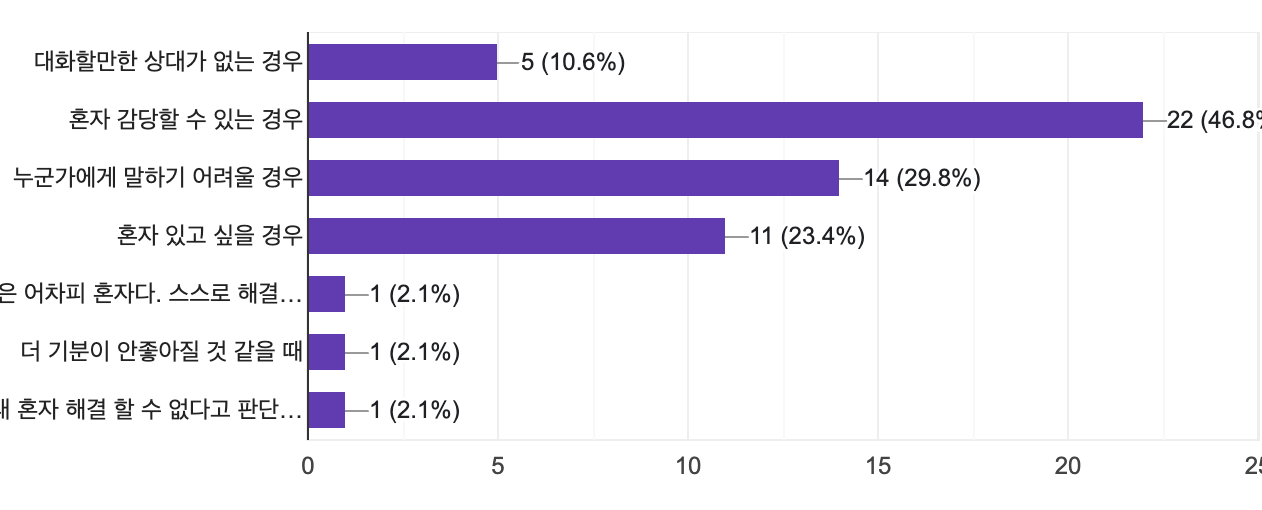
When I try to handle things on my own but can’t:
- It’s often because it’s hard to talk to someone (28.3%)
- Or because I feel like there’s no one to talk to (10.9%)
Ultimately, empathy is key to reducing people’s stress, and we need to address the challenges of those who find it difficult to “talk to someone” when trying to resolve issues alone.
Take No Action,
Talk With Someone

Empathize,
Similar Experience
Hard to talk with someone,
No One To Talk With
User Interview
Sanghee Lee / Developer / Female / Age 30
When I’m struggling, I tend to sigh a lot and talk to people.
Since I spend a lot of time at work, I often don’t get the chance to talk to friends, which makes it hard to relieve stress immediately.
When I do talk to someone to relieve stress, it’s usually with friends, but because our lives are so different, I sometimes feel like they don’t fully empathize with my situation. It makes me hesitant to share everything. Occasionally, I even feel like my friends aren’t on my side.
Although it’s more comforting to talk about my problems than to bottle them up, I sometimes want to resolve things on my own because I later feel embarrassed about what I’ve shared.
It’s hard to gauge how stressed I am sometimes. I tend to suppress my emotions, and they build up until they eventually explode. I’d like to be more aware of my overall emotional state beforehand.
How can we make it easier for people to share their difficult feelings,
no matter where they are, receive empathy for their emotions, and organize their everyday feelings to alleviate stress?
Challenge
- Lack of someone to talk with
- Desire for empathy from someone on their side
- Need for an objective assessment of mental state
Persona

- Yuna Kim
- Female
- Web Designer
- Seoul, South Korea
1. Aspiration
Due to high stress, she struggles to focus on work or daily life.
Having moved to the city alone, she feels like she doesn’t have anyone who is fully on her side. She craves empathy for her situation.
2. Frustration
2-1. Since she left her hometown, her close friends live too far away to meet easily, and she frequently works overtime.
2-2. Her friends have different life circumstances and can’t empathize with her situation.
2-3. Sometimes, she doesn't even understand her own emotions.
3. Interests
Drawing, watching YouTube, shopping.
4. Traits
Cares a lot about others’ opinions
Introverted and Sensitive
User Journey Map
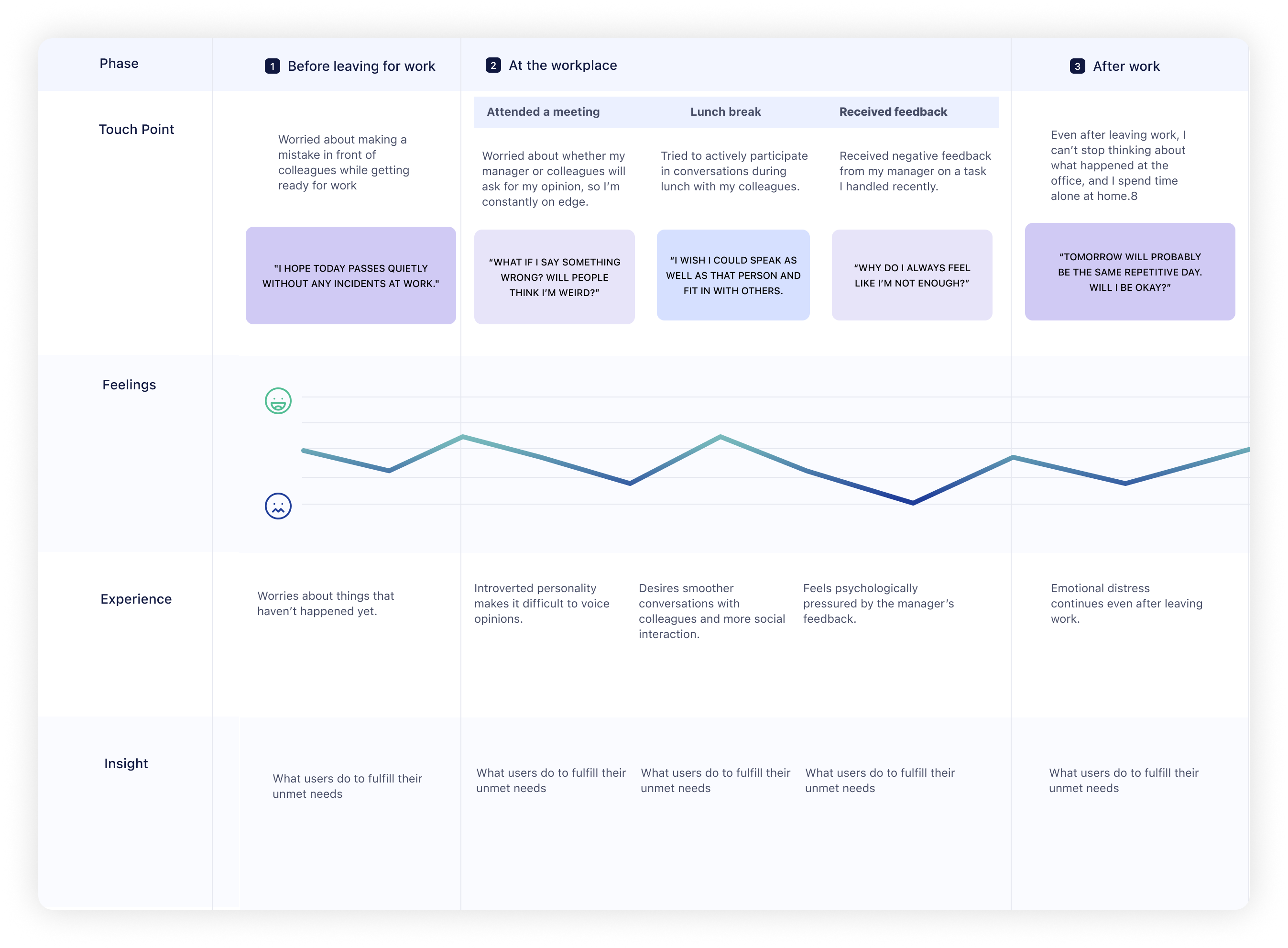
Key Insight
Ideation
Key functions
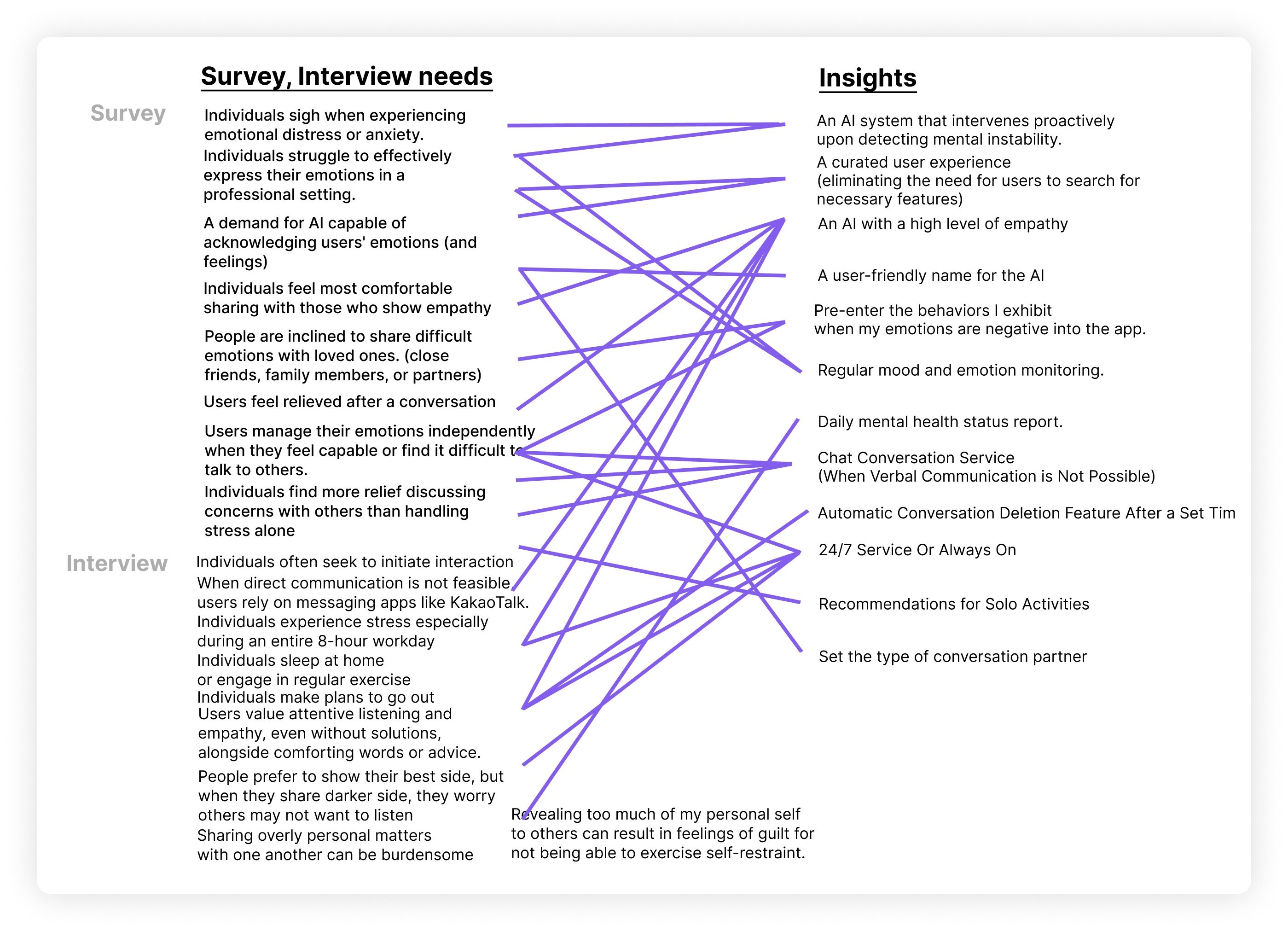

Key Features
1. Application Requirements
The implementation of Artificial Emotional Intelligence (AEI).
Artificial Intelligence text functionality (chatbot feature)
Personalization features (save/change AI settings)
Voice capabilities
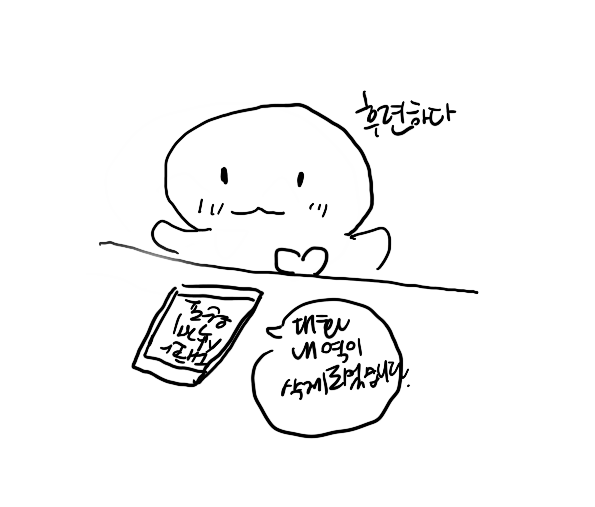
Conversation history deletion feature
Artificial Intelligence functionality
2. Information
Mental health report
User behavior information
based on emotional changes
Basic AI settings information
Basic user information
3. UX
“How are you feeling today?”
“How would you like to talk?”
“Chat or message?”
Your stress level yesterday was 00,
which is 00 higher than your usual average.
Let me track your well-being more closely
please complete the setup.
4. Other Features
Personalized Recommendations
Real-time Status Monitoring
Generate Reports / Organize Data
Auto-delete Conversation Timer
Set AI Persona: Family, Friends, Partner
Key Takeaways
- Set up AI to match your personality, with the option to have AI initiate conversations.
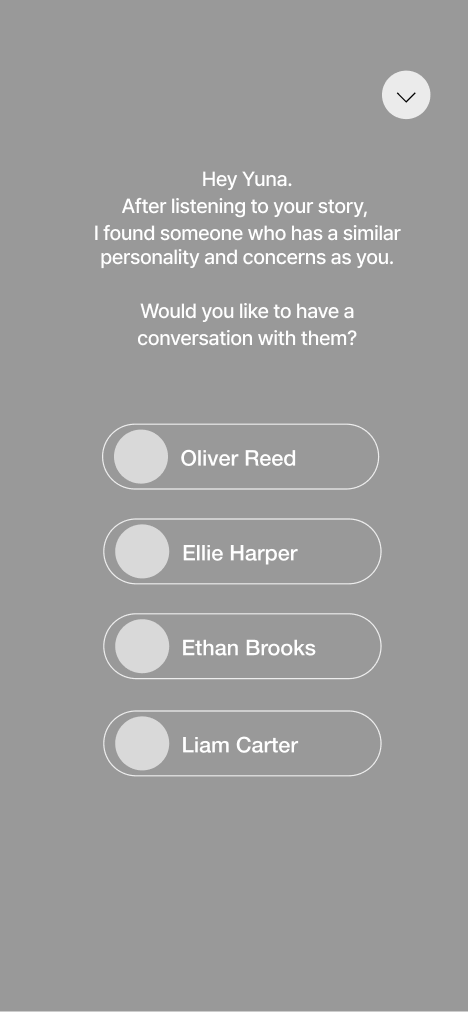
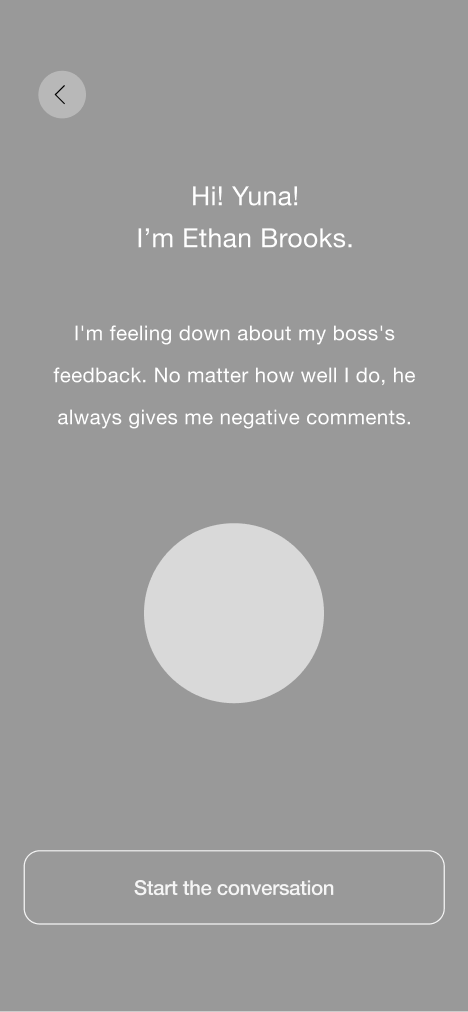
- Connects people in similar situations and with compatible personalities.
- Provides an emotional report.
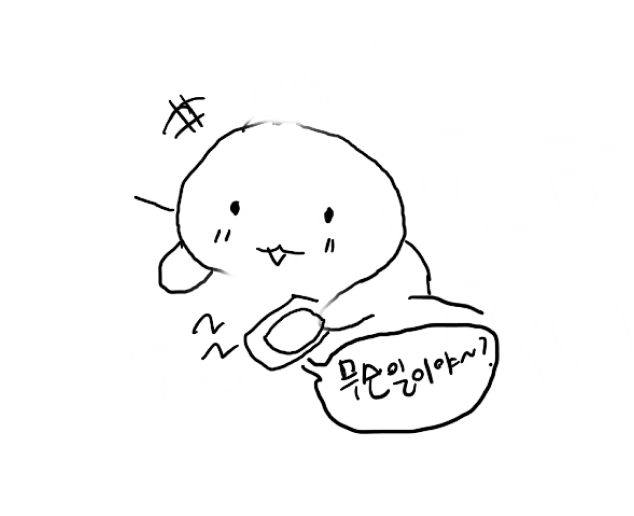
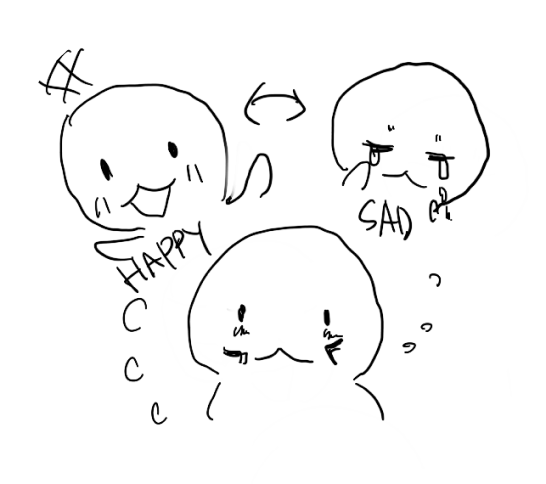
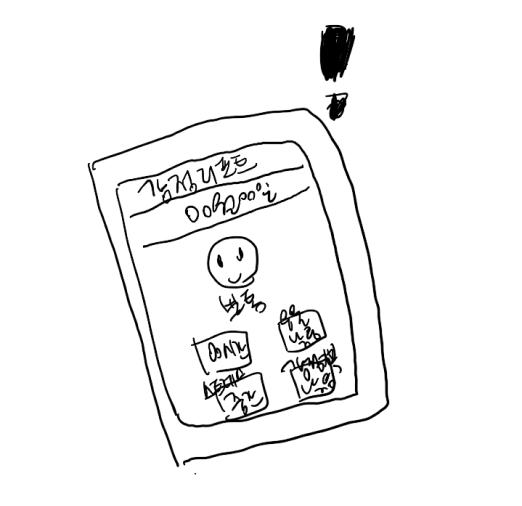
User Scenario
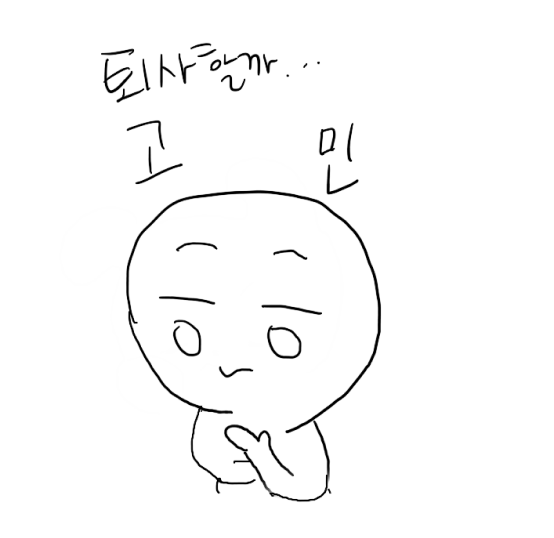
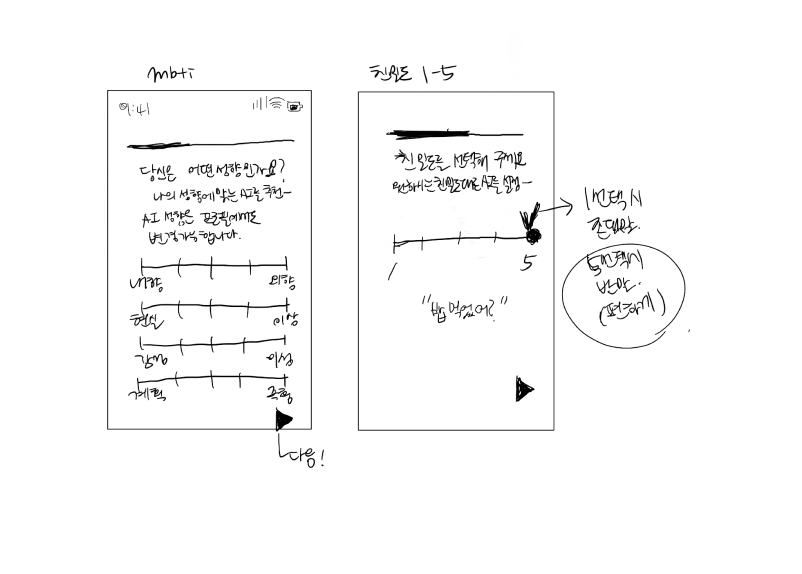



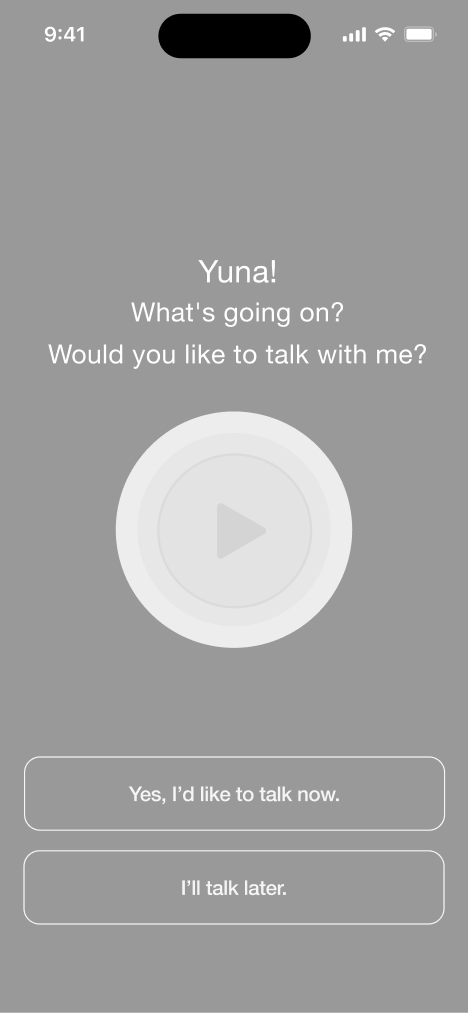
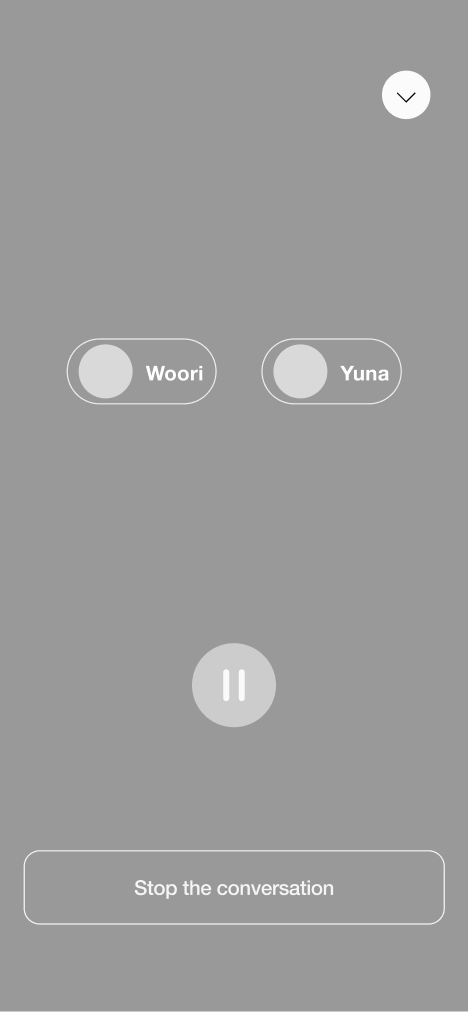
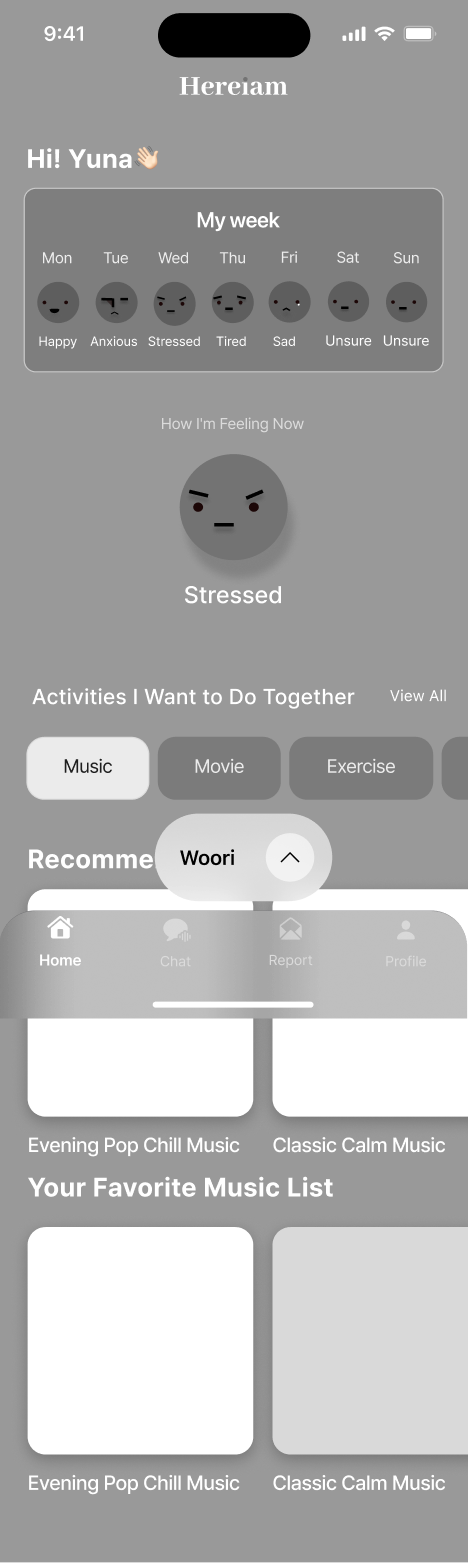
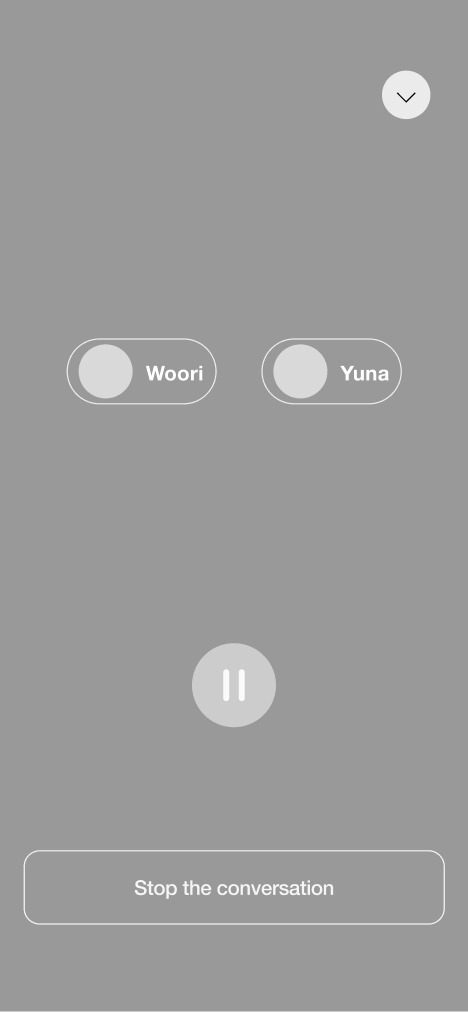
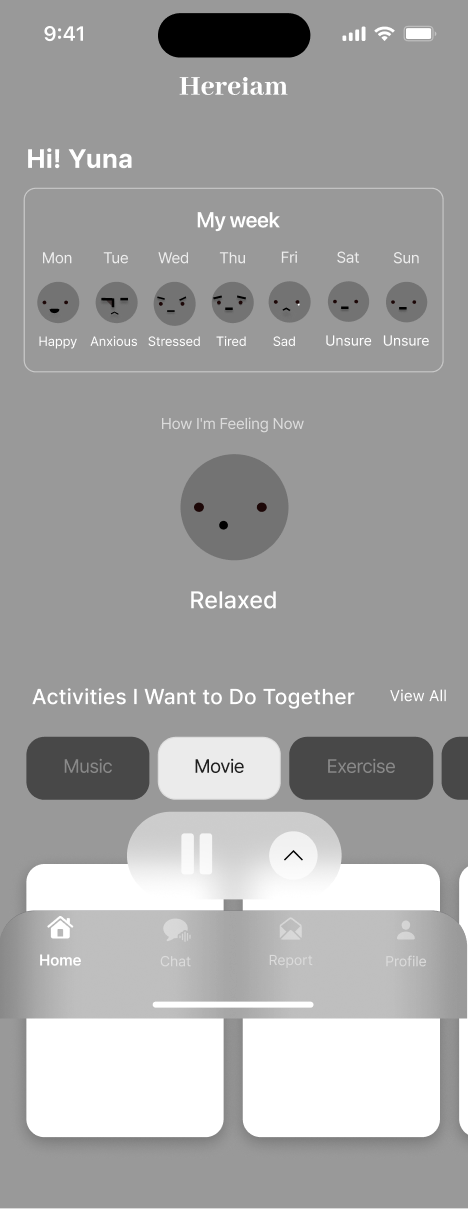
Wireframe
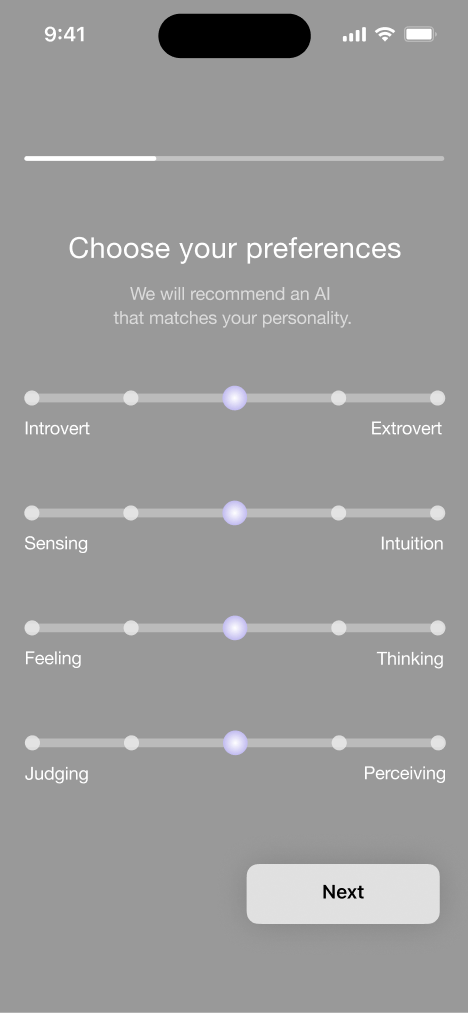
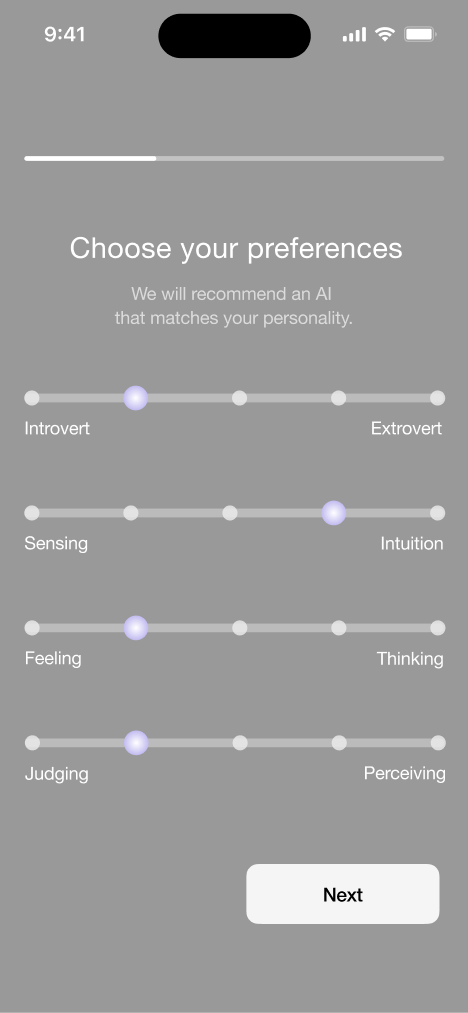
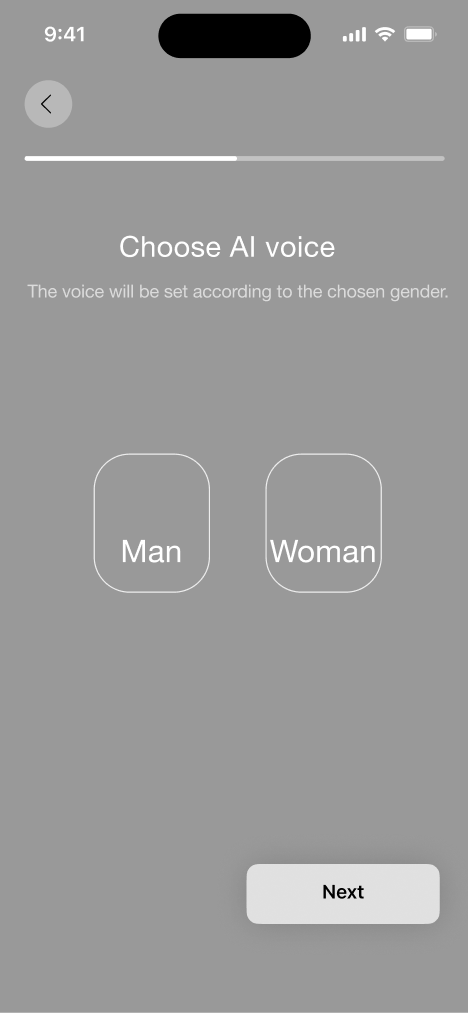
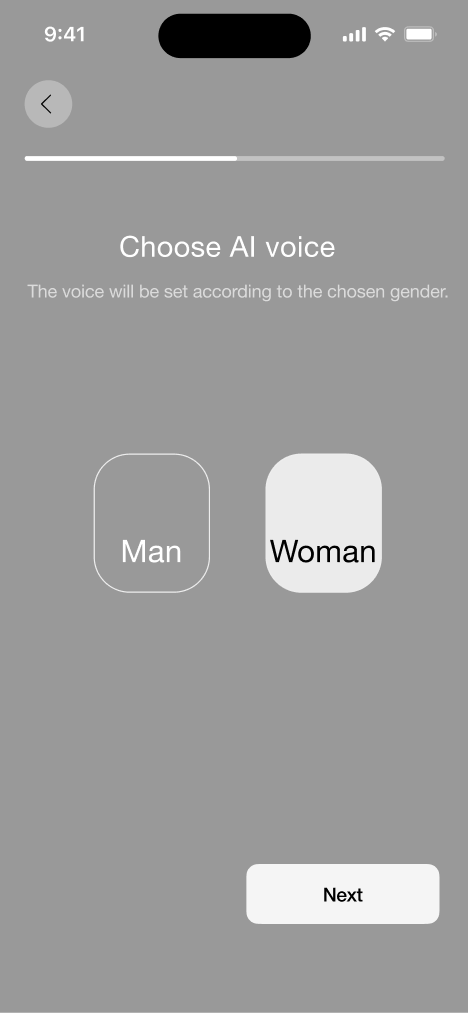
Onboarding


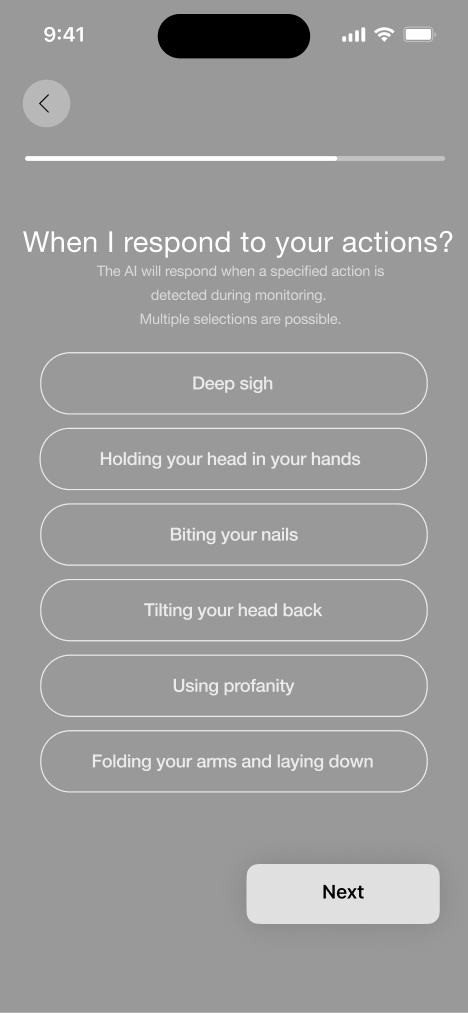
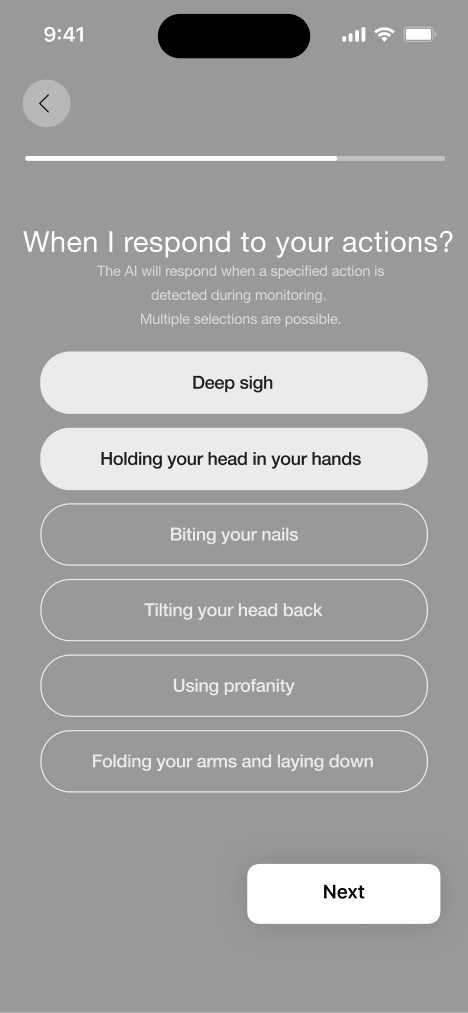

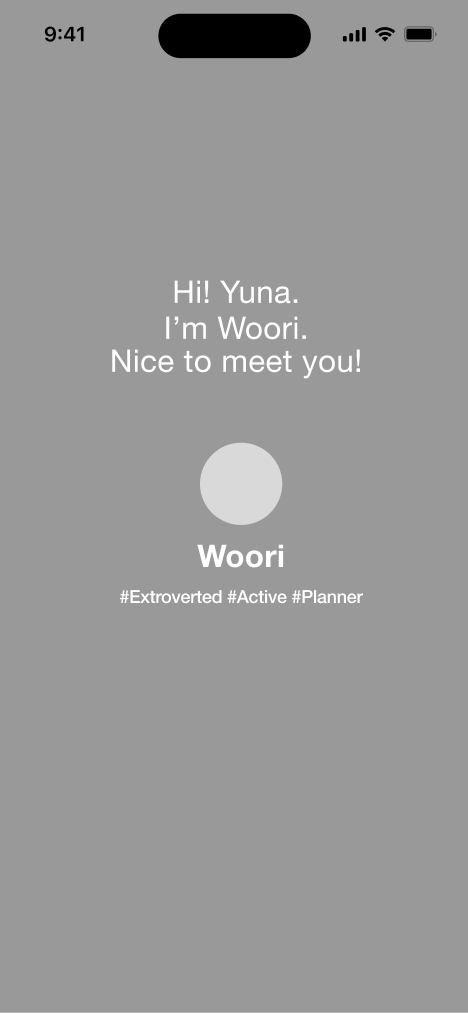
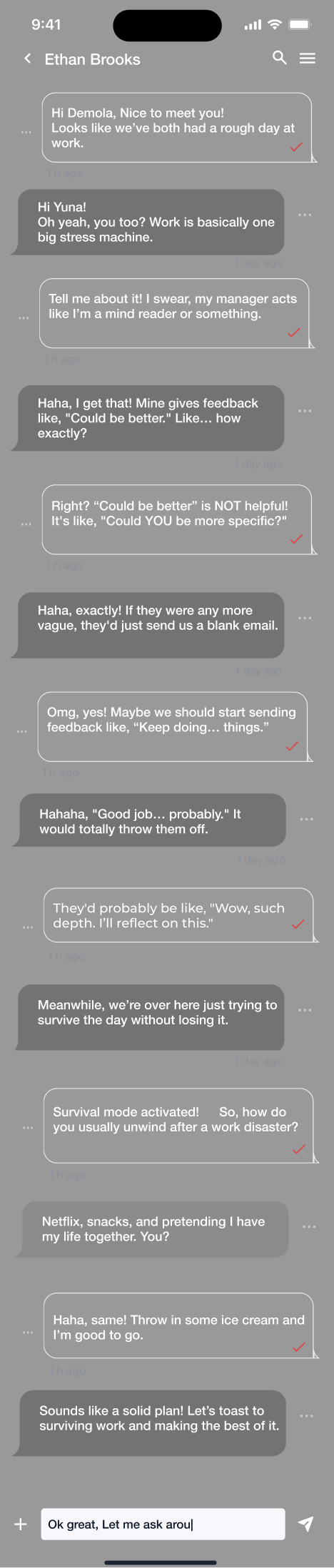
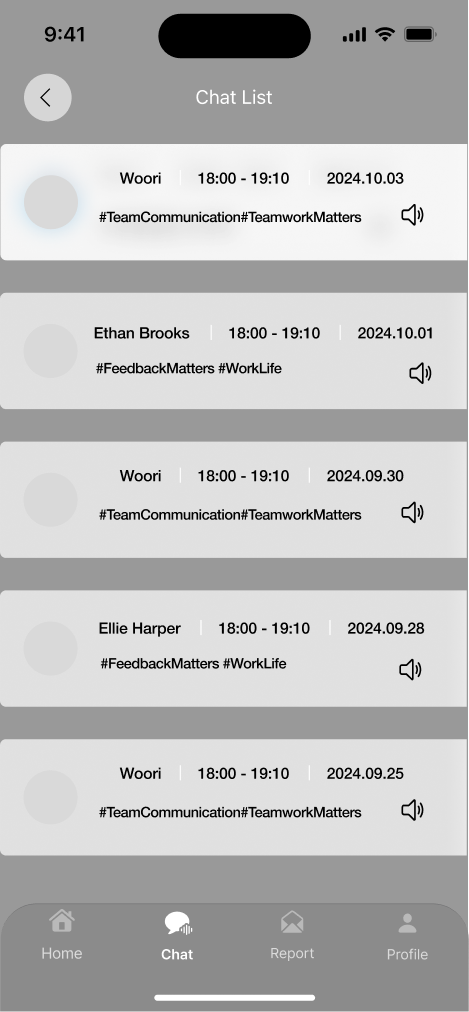
Chat
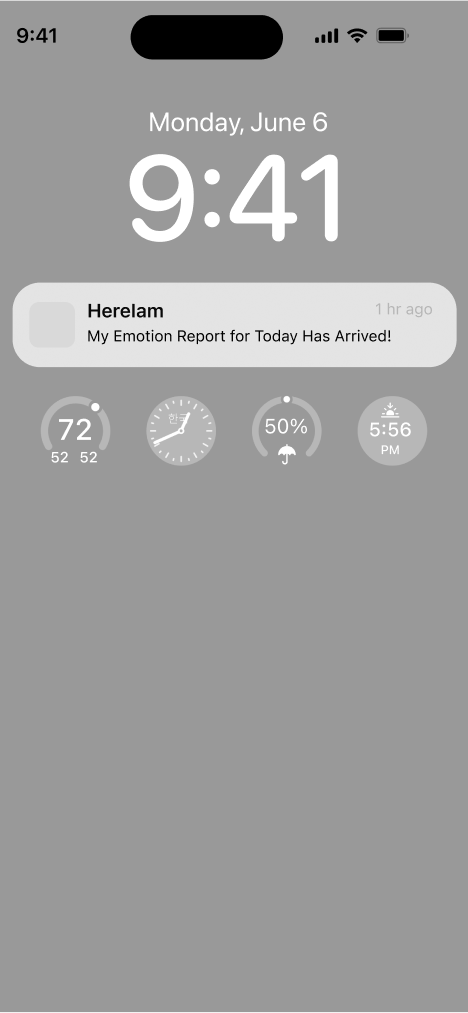
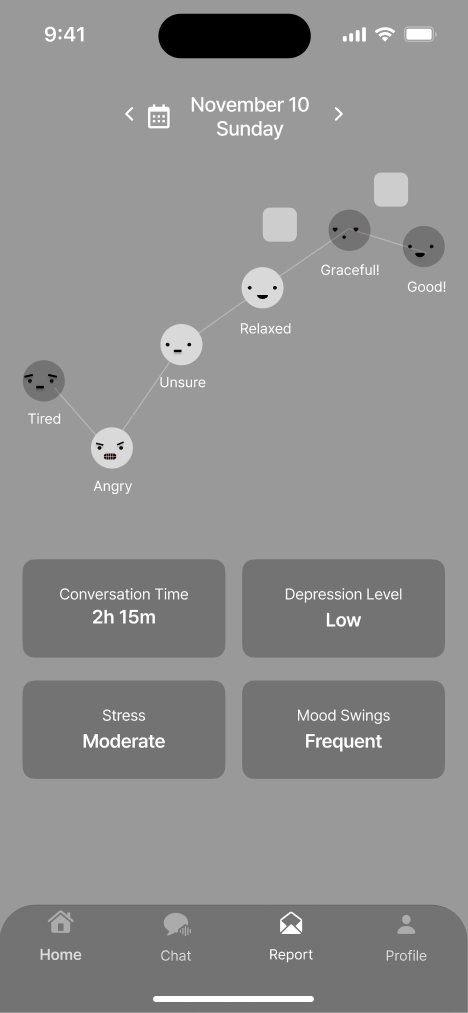
Report & Activity

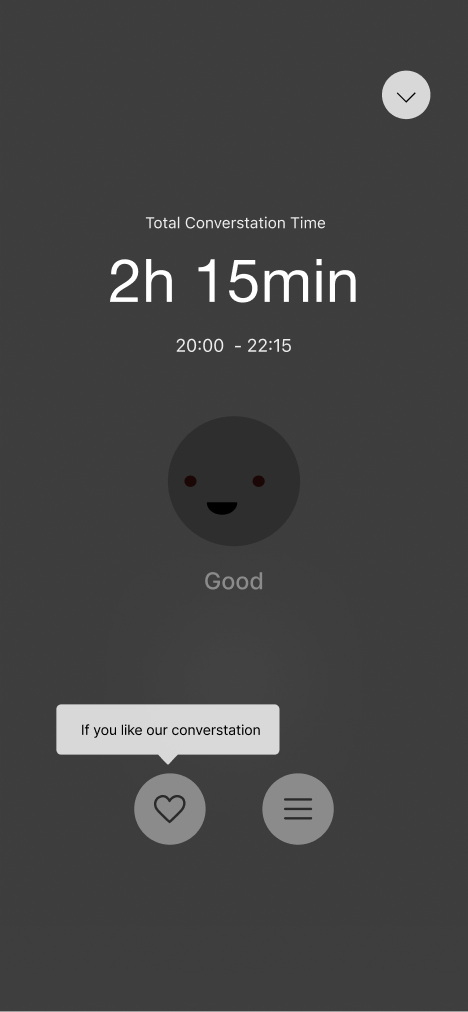
Key feature
Hi-Fidelity Design
Key Feature 1: Personalized Approach
The app allows users to select their personality type and set an AI intimacy level during onboarding.
Based on their concerns and emotional state, users are matched with an AI tailored to their personality, creating a safe and judgment-free environment for self-expression.
Key Feature 2: Proactive Support
The AI companion detects signs of stress or anxiety and initiates supportive conversations.
Users can connect with others in similar situations, fostering meaningful connections and emotional support.
Additionally, users can delete sensitive or personal conversations at any time, ensuring privacy and control.
Key Feature 3: Emotional Tracking
The app provides daily emotional tracking reports, helping users monitor stress levels and mood fluctuations.
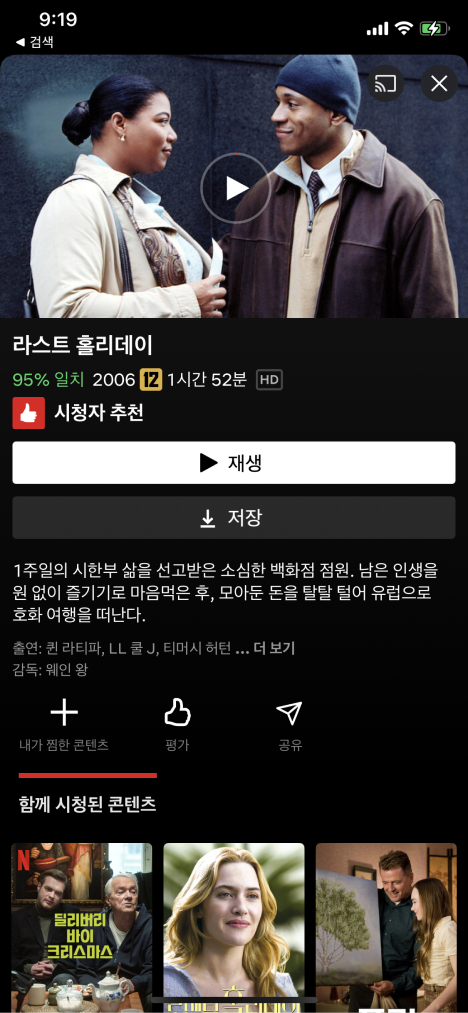
It also offers personalized suggestions for activities to reduce stress, enabling users to maintain better emotional balance in their daily lives.
Design System
Logo


Font

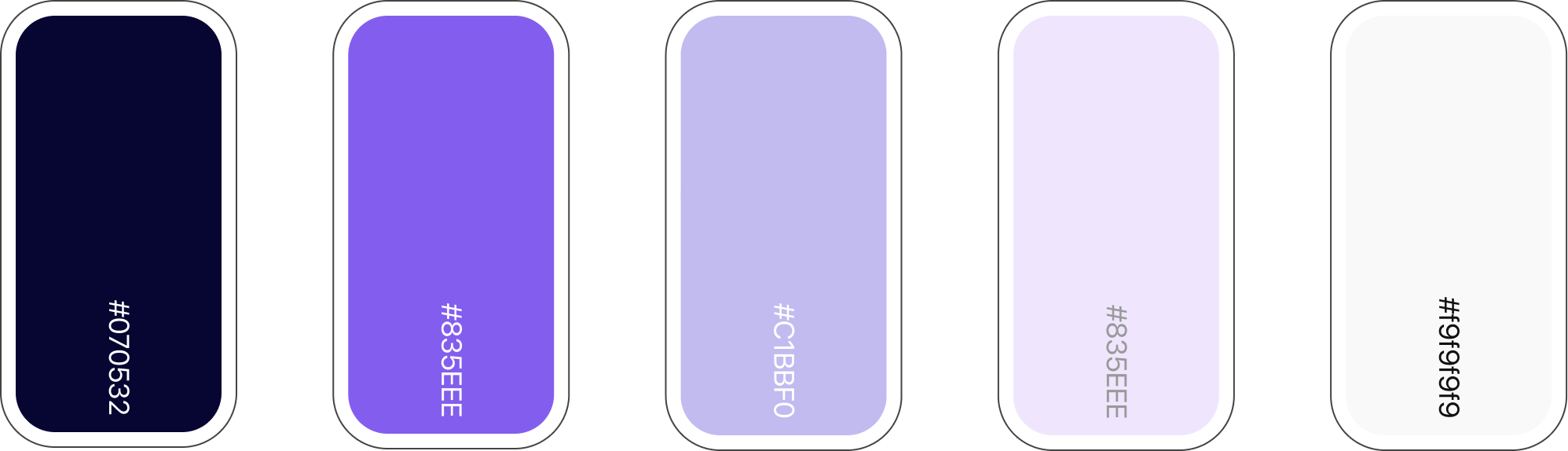
Color Chart
User Test

- Hana Jeong
- Female
- Government Employee
- Ulsan, South Korea
Keyfeature 1
Good: The personality settings were easy to understand and made it simple to configure.
Improvement: I’d like to be able to customize the AI by adding a character or photo of my choice.
Keyfeature 2
Good: I liked how the AI responded to my sighs, making me feel like someone was there with me. It wasn’t just about connecting with an AI, but eventually, I felt emotionally healed through conversations with people who could relate to me better.
Improvement: It would be helpful to have a feature to block or verify people in case someone turns out to be problematic. I’d prefer if there was a verification process for people first.
Keyfeature 3
Good: The report was useful, and I liked that there was something to do alongside it.
Improvement: I’m the type who relieves stress by cleaning or organizing, so it would be nice to have that category included.
Conclusion
Through this project, I realized that AI can help people, but ultimately people want empathy from others. This insight was reflected in core feature 2, where we wanted the service to not only relieve stress, but also provide connections between individuals.
I thought it would be helpful to add features like user authentication via UT and more activities that people could do together.
See next
 Ready Action: An AI Scene Partner That Listens, Performs, and Coaches
 Gus in the Room: Bringing a Dog Into the Classroom Through a Robot’s Eye
 Toilet Delivery: Dignified Restroom Access for NYC Delivery Workers
 Sober Buddy: An AI Player That Joins the Table
 Budgie: Keeping Friendships Alive, One Chirp at a Time
 Dusty & Co.: Designing “Soft Clarity” for a Pottery Studio
 DriveBoy: An Emotional Co-Driver for Long-Haul Truck Drivers
 Industrious: Creating Natural, Authentic Connection in Shared Workspaces
 Baekgomtang: A Climate Crisis Campaign Website
 Octofix: A Direct Alteration Service for Purchase and Repairs
 Exhibition Assistant: Planning an Exhibition Day Made Easy
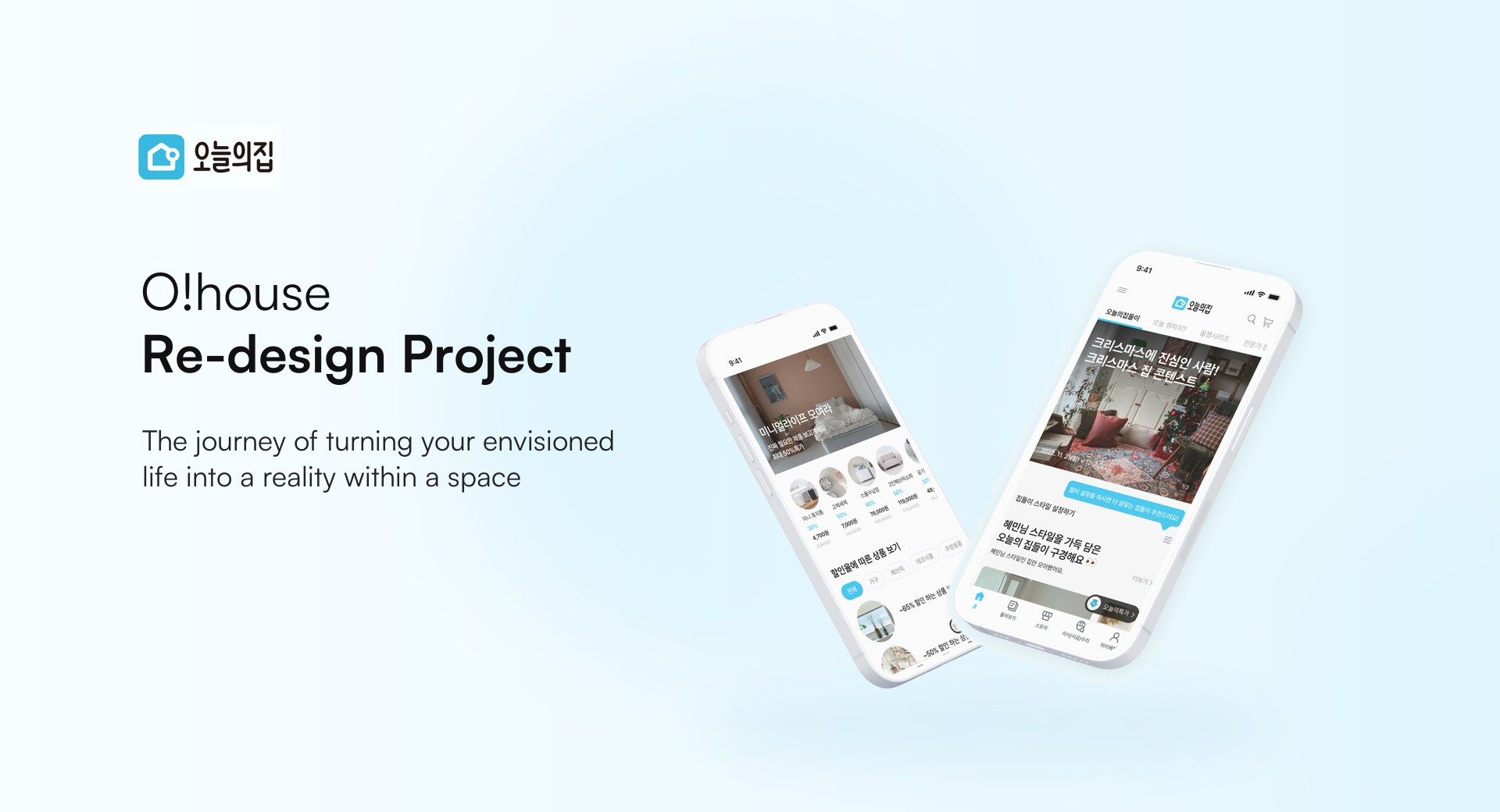 O!house Re-design: Personalized Home Tours and Deals← All work